September 2022 – present (expected defence by 1 September 2026)
PhD Candidate, Experimental Physics
Kläui Group, Johannes Gutenberg University Mainz · supervised by Prof. Dr. Mathias Kläui
Thesis on the structural and magnetic nature of single-crystal layered magnetic
materials. Built all measurement devices from scratch, from mechanical exfoliation and
dry-transfer stacking through to the cryogenic transport, SQUID, and NV-magnetometry
measurements themselves, and wrote the Python instrumentation software (CryoSoft) the lab
now uses for cryogenic transport measurements. Five peer-reviewed publications over four
years (three first/shared-first-author research articles, one lead-author invited
perspective, one co-author article). Established the in-house SEM/EDX characterisation
workflow used across the group's fabricated devices, and co-supervised three junior
researchers (two summer interns, one Master's student awarded top grade) across the PhD.
May 2026 – present
Lead, AI and Digitalization Taskforce
Kläui Group, Johannes Gutenberg University Mainz · part-time, alongside the PhD
Proposed the lab's first AI roadmap to the group leader and was appointed to lead its
six-member taskforce. Put the university's first research-group AI chatbot into production
for the ~50-researcher group: it answers from the group's wiki and a literature corpus of
10,000+ papers, cites its sources and shows the relevant figures. Built the agentic
retrieval behind it (figure Recall@10 0.92) and made the lab's cryogenic instruments
operable by AI agents through an MCP server and the I2AS framework. Won the university's
first Microsoft 365 Copilot premium licences for the group, plus a dedicated server and
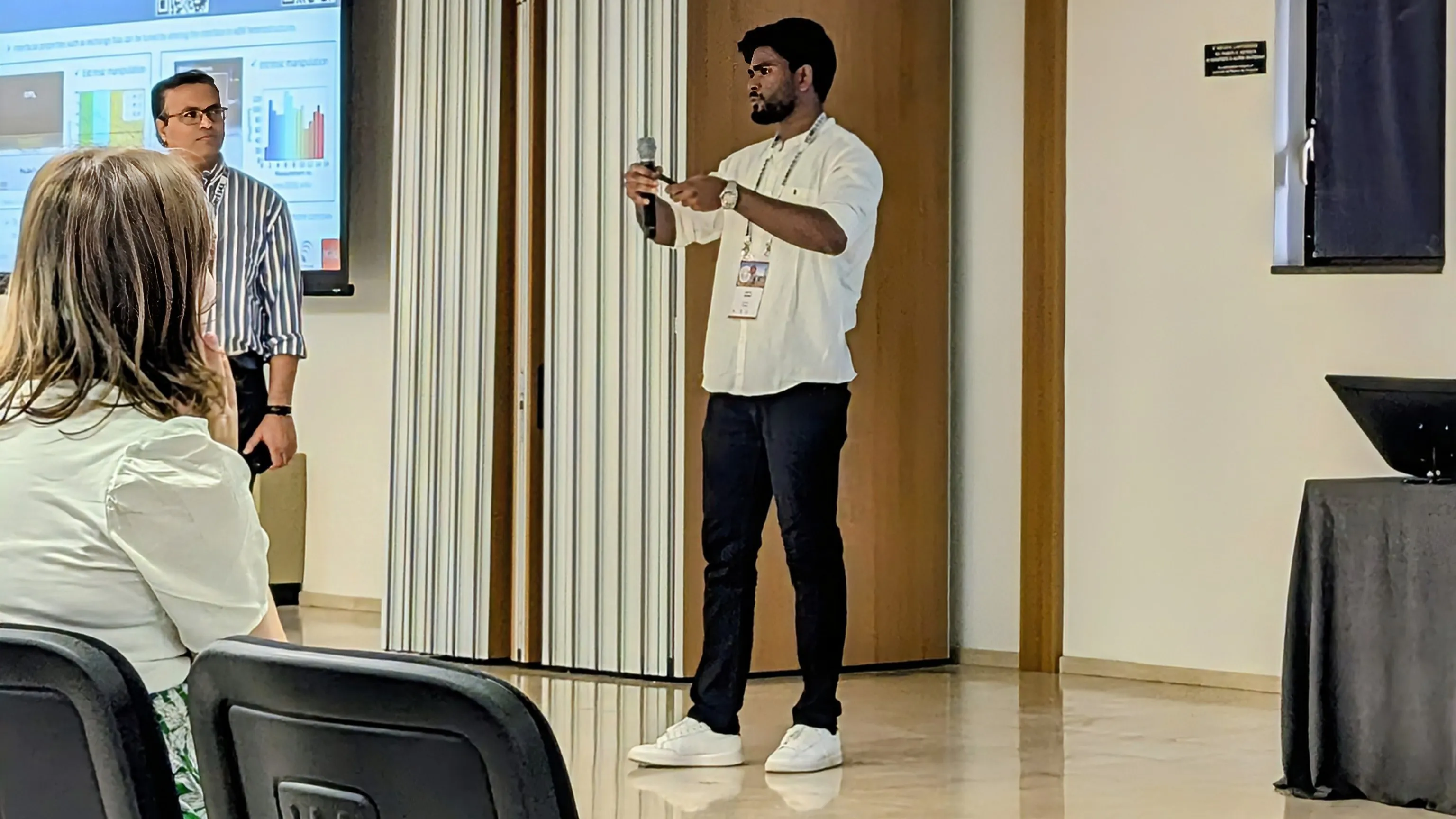
model API access, from central IT. Presented the work at AI4Science 2026 in Mainz.
June 2024 – December 2025
Elected Supply Chain Manager, Supply Chain 1 (Antiferromagnetic and Altermagnetic Spintronics)
TRR 173 Spin+X · RPTU Kaiserslautern-Landau and JGU Mainz · DFG-funded, EUR 11 million transregional consortium
Peer-elected to coordinate a research "supply chain": the end-to-end pipeline from
growing a material, to measuring it, to modelling it theoretically. Chaired monthly
cross-group meetings for 20+ PhD researchers and postdocs across two universities, and
brokered collaboration across group boundaries. Led two interdisciplinary Seedfund
proposals (2024, 2025, both runner-up) and co-led the 2026 cycle, which won the
consortium-wide peer vote with 14 of 24 votes and is now funded and in implementation (an
NV-centre benchtop antiferromagnet-imaging proposal). Also engaged in TRR 173
consortium-wide governance alongside student representatives and the Young Researcher
College manager.
September 2022 – December 2025
Co-organizer and Mainz contact, Peking-Mainz Exchange Program on 2D heterostructures (MaP-2D)
Sino-German Center for Research Promotion · joint DFG (Germany) / NSFC (China) mobility grant
Co-organized four bilateral meetings between Chinese and German researchers working on 2D
materials, including the Third China-Germany Bilateral Meeting (Beijing, October 2024: 41
scientific presentations, over 100 participants). Led the draft of the mobility project's
final report, delivered on schedule to the funding agencies.
September 2021 – August 2022
Visiting Researcher (pre-PhD)
Kläui Group, Johannes Gutenberg University Mainz
Read out the Néel-vector orientation of the semiconducting antiferromagnet CrPS4 via
spin Hall magnetoresistance in Pt/CrPS4 heterostructures. Established the full
nanofabrication chain for the subgroup (polymer-based exfoliation and vdW stacking of
CrPS4 flakes, MBE and sputter deposition of Pt thin films, electron-beam lithography, ion-
beam etching, sputter-deposited gold contacts) and built the cryogenic SMR measurement
workflow on a 12 T superconducting magnet, presenting the findings at the internal Kläui
Group yearly evaluation. Built the foundational experience in cryogenic spin transport and
metal-semiconductor interface measurements that fed forward into the PhD magnon
spin-valve project.
June – July 2018
Summer Research Intern
Computer-Generated Holography and Optical Imaging Laboratory, Prof. B. R. Boruah · IIT Guwahati
Built a 9,000 FPS DMD-based laser wavefront-shaping pipeline driven by computer-generated
holograms, with hologram-side aberration correction via Zernike-coefficient tuning;
hardware control and data acquisition in MATLAB and LabVIEW.