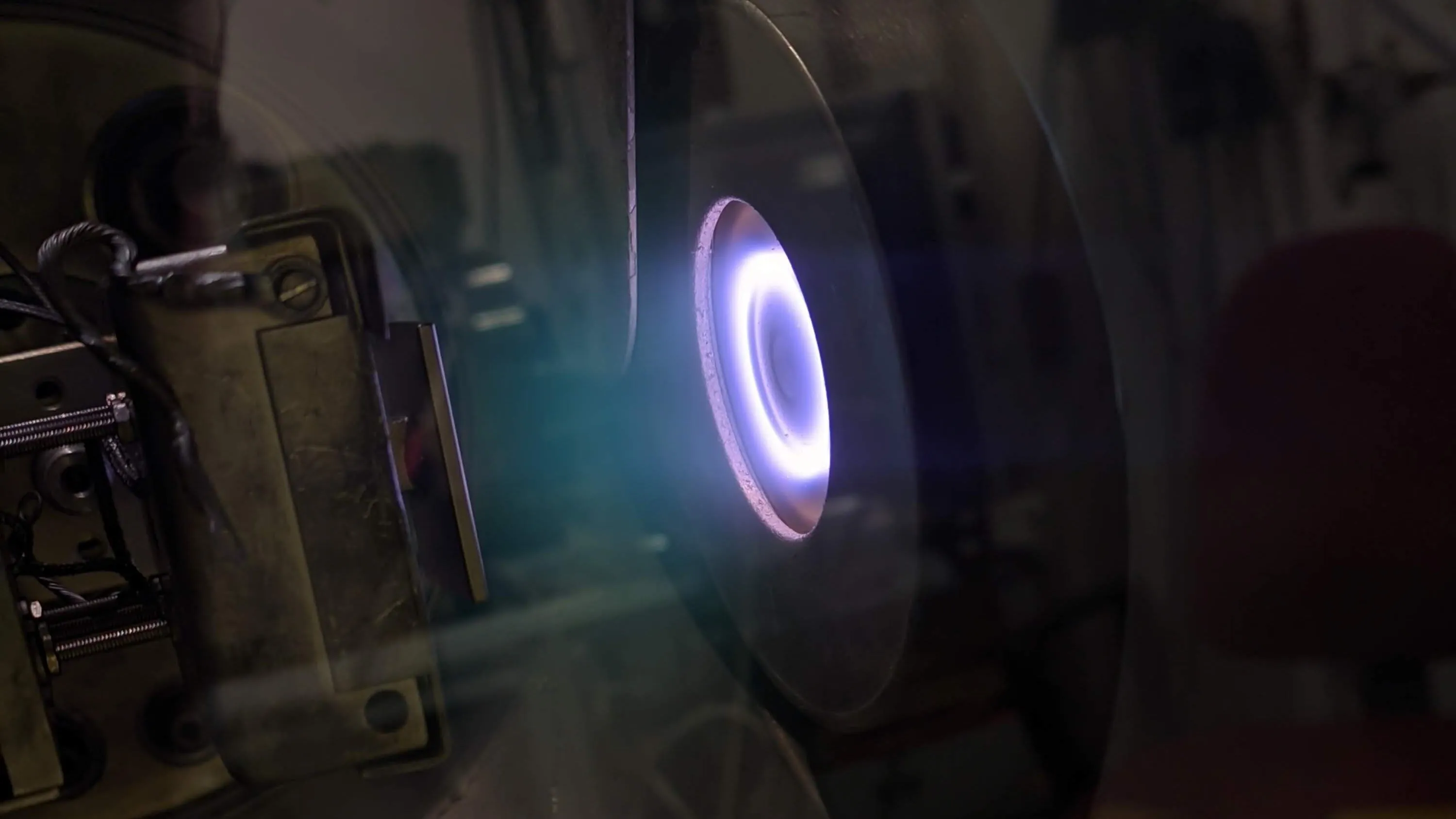
A sputter deposition source seen through the port of a darkened vacuum chamber, its target ringed by a bright violet-white plasma glow.

Selected work

Work

Each entry leads with what came of it; the method is on its own page.

Each entry leads with what came of it; the method is on its own page.

AI and automation

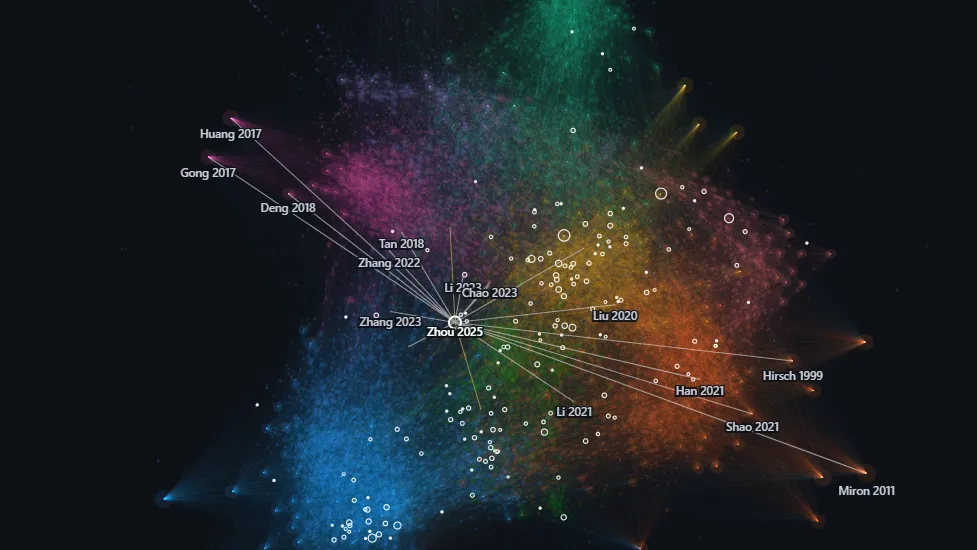
The lab's literature as a citation map on a dark background: thousands of papers drawn as points in clouds of blue, orange, teal, pink and violet, one colour per research community, with a few highly cited papers labelled by first author and year and lines fanning out from one 2025 paper at the centre to the papers it cites.

Agentic RAG · 2026–present

A lab's literature of more than 10,000 papers, searchable by AI agents with every answer traced to the passage it came from.

Agentic domain-specific RAG

  • 10,000+ papers and theses
  • 0.92 figure Recall@10
  • 0.77 passage Recall@10
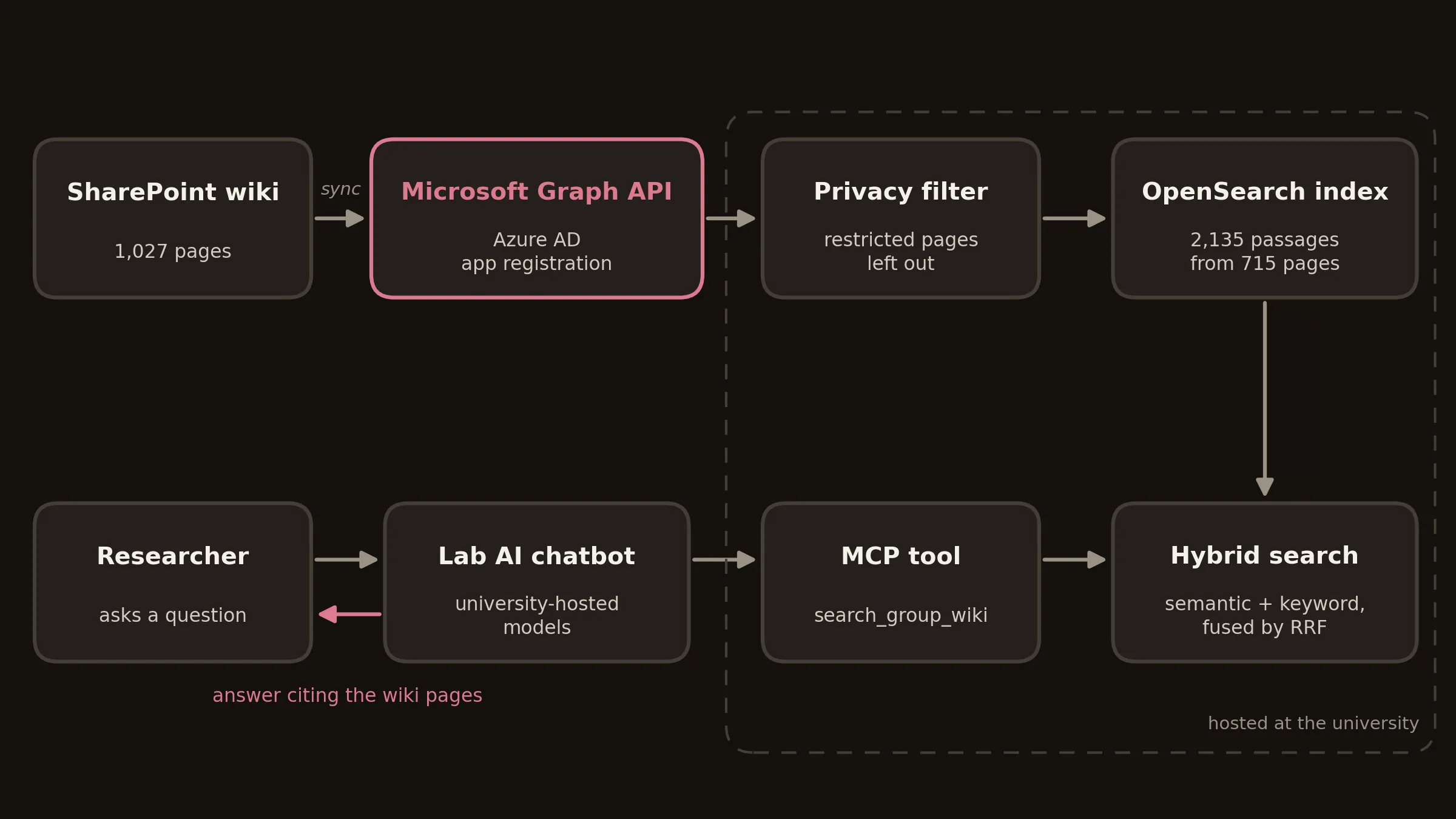
A schematic on a dark ground. Top row: the SharePoint wiki of 1,027 pages syncs through the Microsoft Graph API, using an Azure AD app registration, into a privacy filter and an OpenSearch index of 2,135 passages from 715 pages. Bottom row: a researcher asks the lab AI chatbot, which calls the MCP tool search_group_wiki, which runs hybrid semantic and keyword search fused by RRF over the index; the answer returns citing the wiki pages. A dashed outline marks the filter, index, tool and search as hosted at the university.

Agentic RAG · 2026–present

The lab's internal wiki answering questions in its AI chatbot, with the right page in the top 10 for 99 of 100 test questions.

Wiki RAG: the lab's know-how on call

  • 1,027 wiki pages synced
  • 0.99 page Recall@10
  • 0.74 passage Recall@1
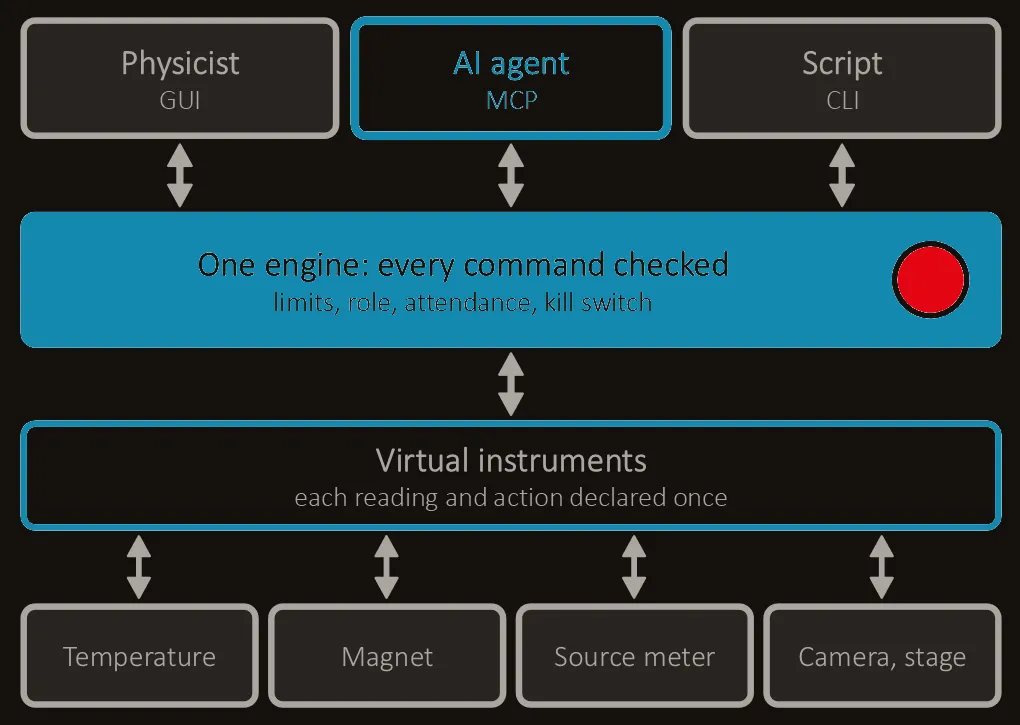
A block diagram on a dark ground: three clients, a physicist through a GUI, an AI agent through MCP and a script through a CLI, each connect to one engine that checks every command against limits, role, attendance and a kill switch, which drives a virtual-instruments layer over four instruments: temperature, magnet, source meter, and camera and stage.

Instrument software · 2026–present

Laboratory instruments that a physicist and an AI agent can operate side by side, with every command checked by the same safety rules.

I2AS: Instrument to Agentic Station

  • 2 setups deployed
  • 4 client surfaces, one declaration
  • 4 agent roles
A line drawing of a cryostat, its outer vessel enclosing an inner chamber with a sample at the centre of a magnet bore, marked in maroon. Circuit-board traces run from the cryostat to five stacked instrument icons on the right: a computer display, a gauge, an oscilloscope, a control unit and a meter.

Instrument software · 2024–present

Cryogenic measurements that run for 30 to 40 hours with nobody watching, inside safety limits the software enforces itself.

CryoSoft

  • 30 to 40 h unattended runs
  • 1 week to 2 hours onboarding
  • 6 architecture layers
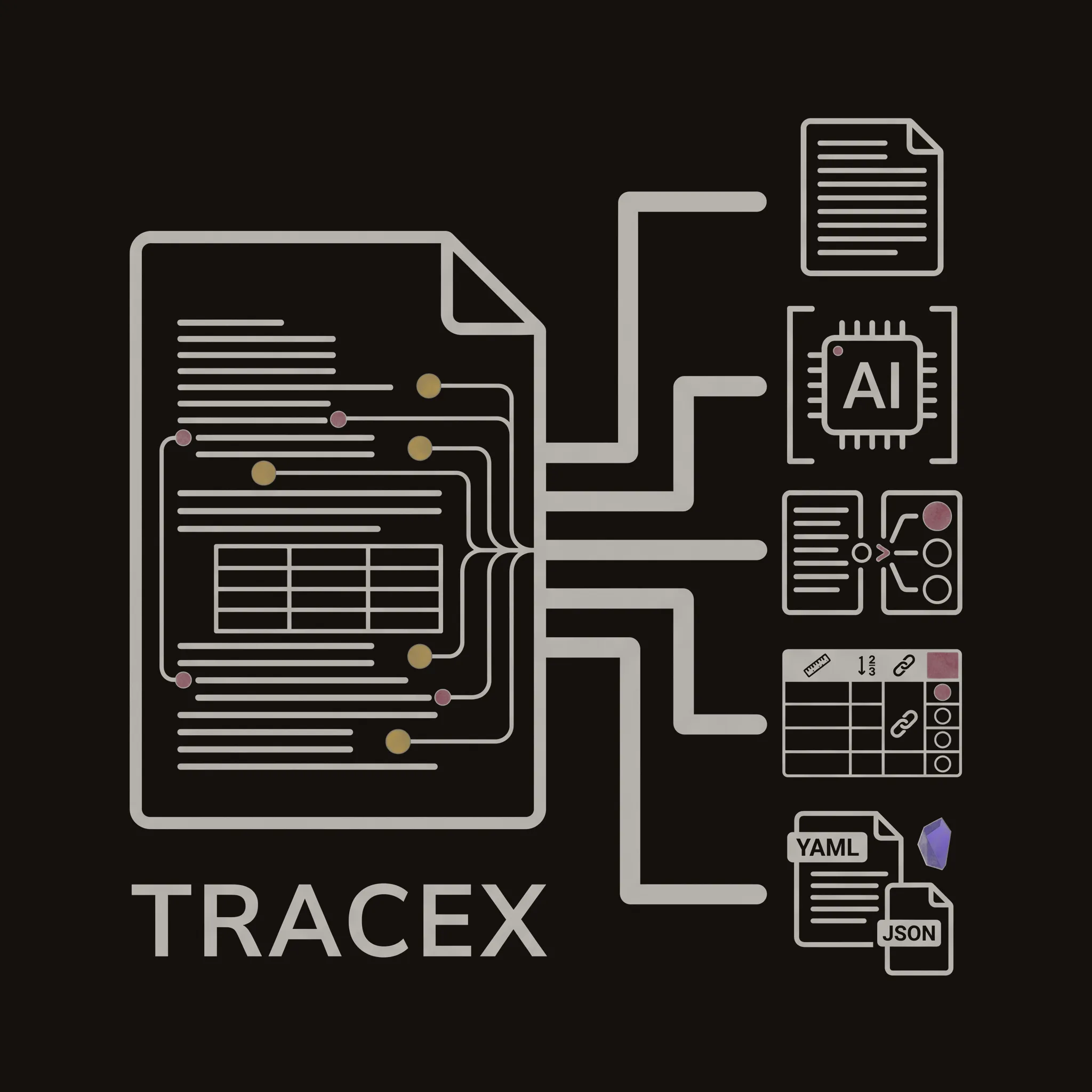
A light line drawing on a dark ground of a document page of text and a data table, with maroon and gold dots marking individual lines. Traced wires run from those marked lines out to the right, where they fan into icons for a source paper, an AI chip, a verification step and a structured note, under the wordmark TRACEX.

Applied AI · 2025–present

Every number pulled out of a paper carries the exact sentence it came from, and a grade for how well that check holds.

TracEx

  • 1 model call per paper
  • A/B/C verification grade per value
  • 3 model providers supported
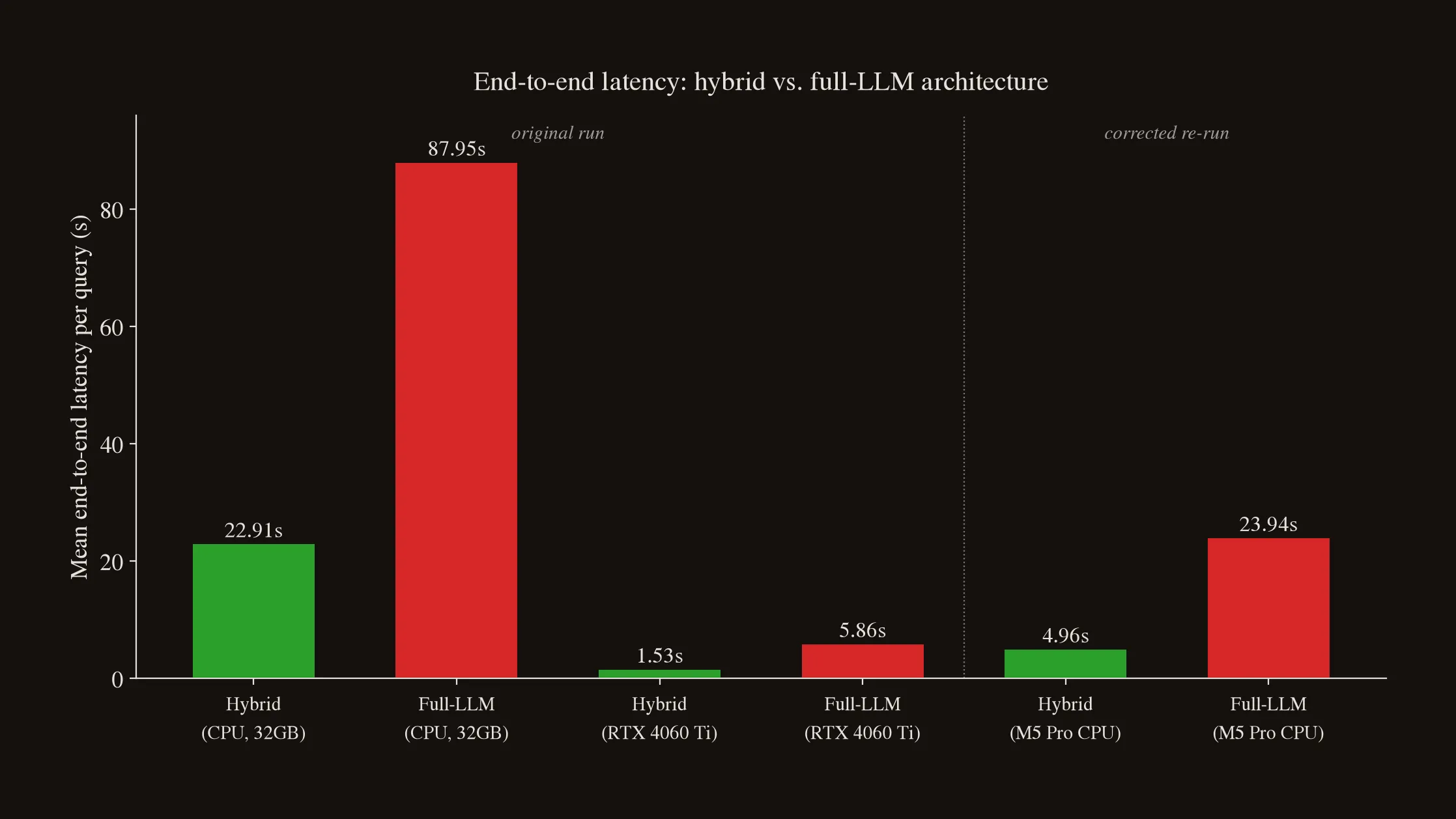
Bar chart on a dark ground of mean end-to-end latency per query, hybrid agent in green against full-LLM agent in red on three machines: 22.91 s against 87.95 s on a 32 GB CPU, 1.53 s against 5.86 s on an RTX 4060 Ti, and 4.96 s against 23.94 s on an M5 Pro CPU.

Agentic AI · 2026

A hybrid agent that answers 3.8–4.8× faster and at half the cloud cost of an all-cloud agent, keeping the data rows on-premises.

Distilled models for a faster, cheaper hybrid AI agent

  • 3.8–4.8× lower latency
  • 2.1× lower cloud cost
  • 0.98 tool-call accuracy
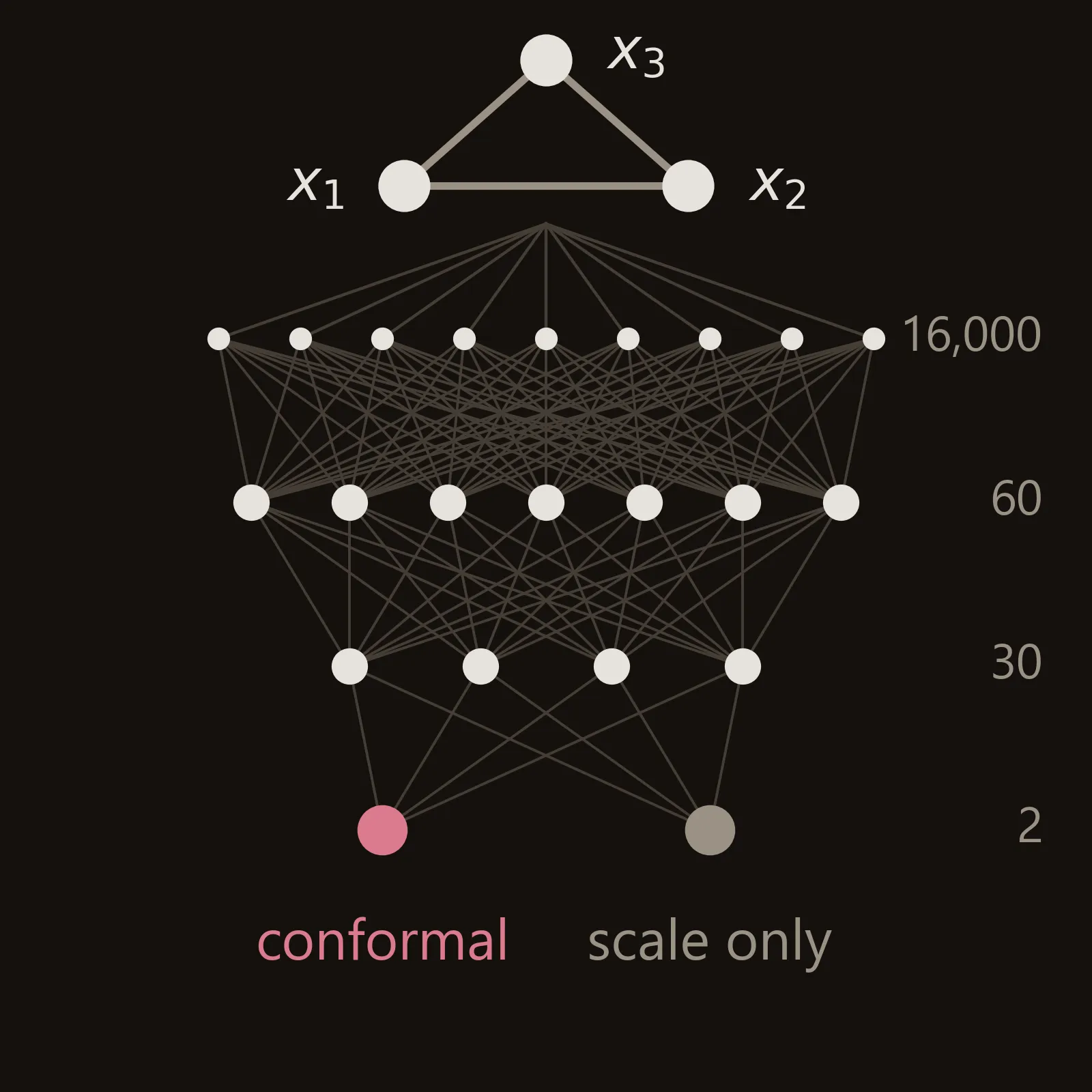
A schematic. Three points labelled x1, x2 and x3 at the top, joined in a triangle, feed a neural network drawn as rows of nodes labelled 16,000, 60, 30 and 2. The two output nodes at the bottom are labelled conformal, in rose, and scale only, in grey.

Applied AI · August–December 2020

A proof of concept that neural networks can tell conformal field theory data apart, with 95% test accuracy on spin-correlator data.

Machine learning applied to conformal field theory

  • 95% test accuracy
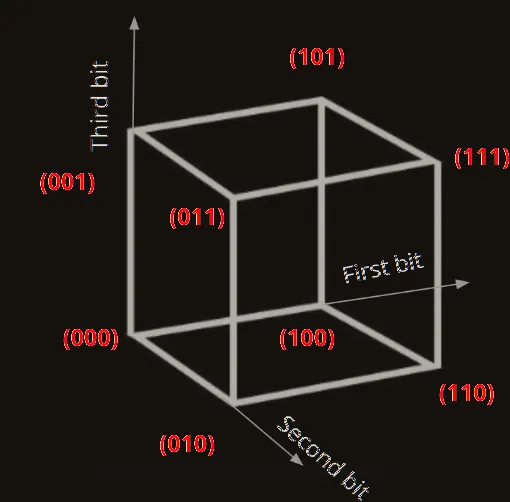
A cube drawn in pale lines on a dark ground with axes labelled first, second and third bit, each corner labelled in red with its three-bit string from (000) to (111): the nodes of the 3-cube the walk searches.

Algorithms · Fall 2019

A reimplementation of quantum-walk search on a hypercube, verified numerically up to a 5-cube against the paper's own estimate.

Quantum search algorithm using a quantum random walk

  • 0.347 target probability at n = 3
  • 5-cube largest verified

Materials research

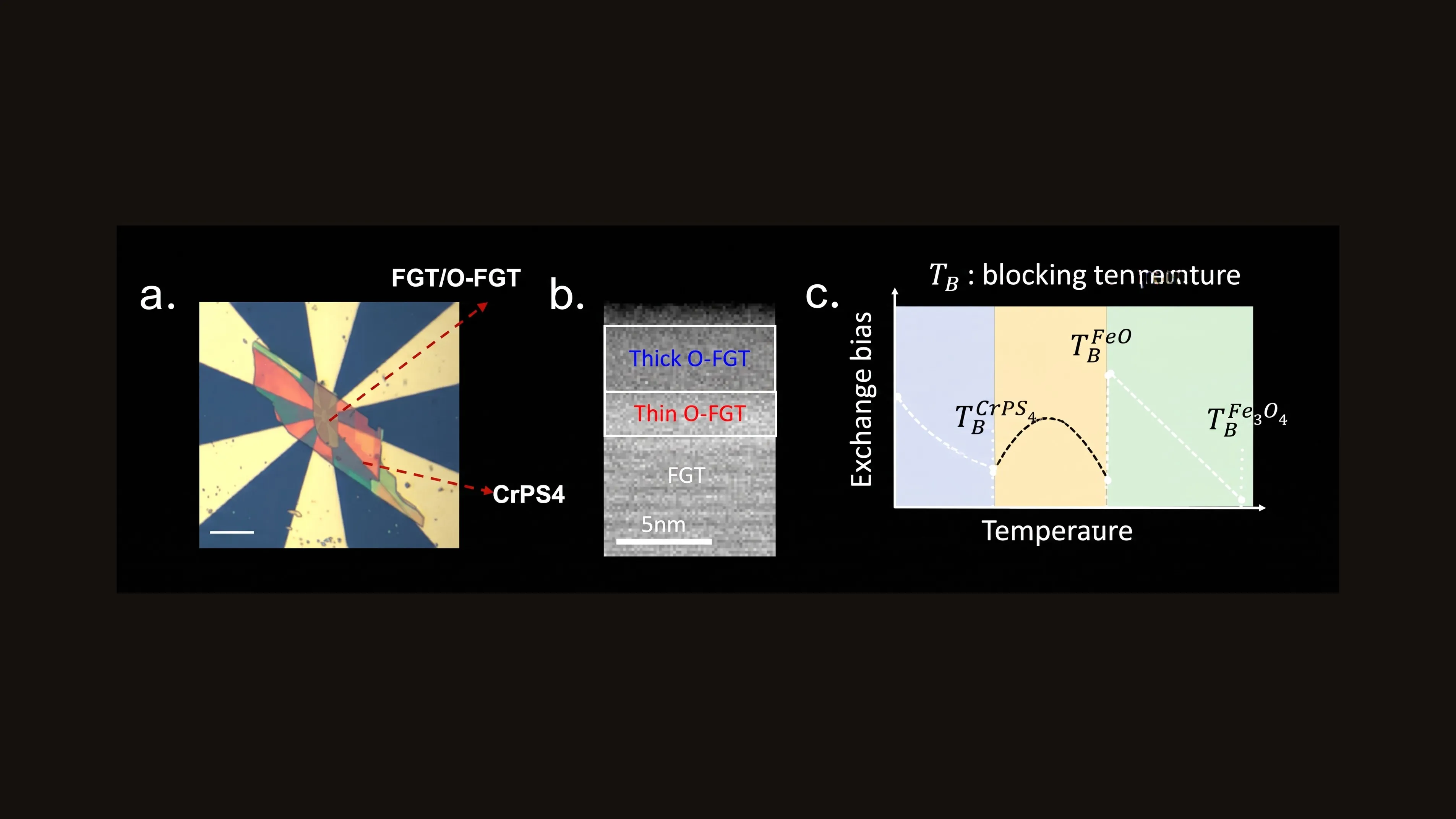
Three panels on a dark ground: an optical micrograph of the device with the FGT/O-FGT and CrPS4 regions arrowed across eight gold contacts; a greyscale cross-sectional electron micrograph showing three stacked bands labelled thick O-FGT, thin O-FGT and FGT with a 5 nm scale bar; and a schematic of exchange bias against temperature divided into three shaded regions marking the blocking temperatures of CrPS4, FeO and Fe3O4.

Research · spintronics

The rust layer everyone treats as damage turns out to run the magnetic coupling, and can reverse its direction.

Surface oxidation as the dominant source of exchange bias

  • ≈140 K blocking temperature
  • 36 K for the pristine control
  • 2 magnetically ordered oxide sublayers