Instrument software · 2026–present
I2AS: Instrument to Agentic Station
Laboratory instruments that a physicist and an AI agent can operate side by side, with every command checked by the same safety rules.
The short version
A lab setup is a rack of instruments from different vendors, tied together by scripts that work only for the person who wrote them, with safety limits, monitoring and metadata rewritten or skipped for each setup. CryoSoft solved this for one cryostat but could not be reused elsewhere without a fork. An AI agent can only be allowed near a running instrument if every action it takes passes the same checks as a human's and is recorded.
The architecture of CryoSoft, made independent of any one station and opened to AI agents. It is the instrument strand of the lab's AI work, alongside the literature and wiki search.
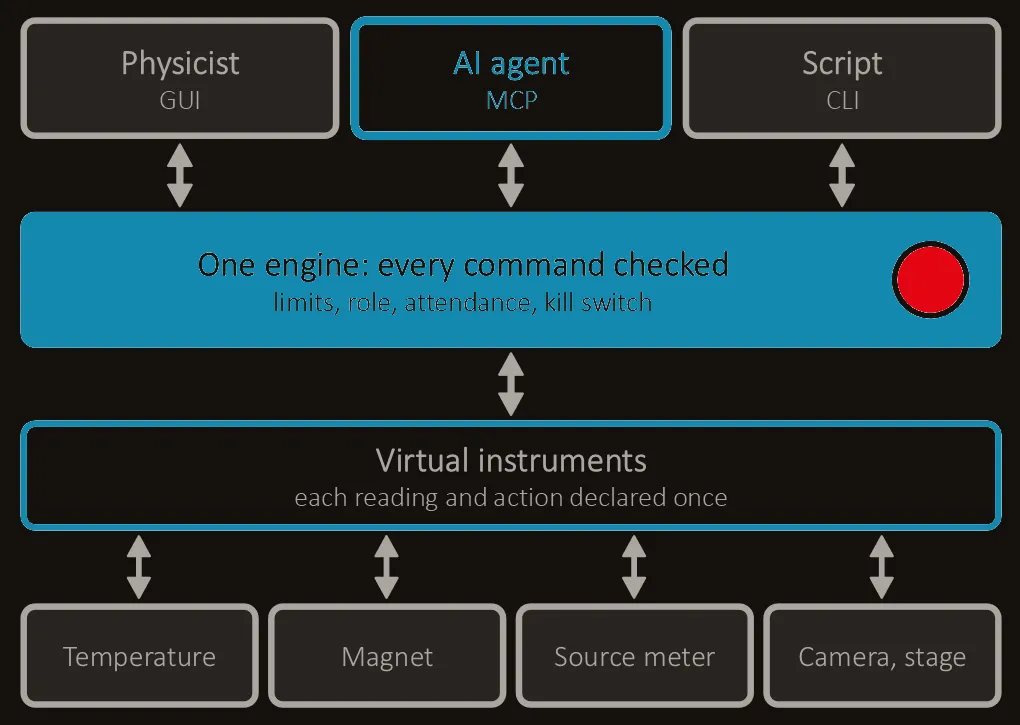
Three kinds of client, one engine that checks every command, one declaration per instrument.
How
- Declared each instrument once, in a Virtual Instrument layer: readings with units, actions with typed parameters, bounds and action classes. The PyQt6 and pyqtgraph GUI, the MCP tools, the Python gateway and the command-line client are rendered from it, and conformance tests keep the four surfaces identical.
- Sent every command through one engine. A button click, an MCP call and a spooled JSON file become the same Command, checked against setup limits, session envelope, attendance, kill switch and run ownership, and answered by one Verdict on a stream every client sees.
- Gave agents authority in steps: a role ladder from observer to human operator, where role ceilings, the kill switch and run ownership can only remove permissions. Remote agents connect over MCP with named access keys.
- Placed code by trust: the tested engine on the instrument thread, user-written blocks in a killable helper process, agent-generated analysis in a container with no network.
- Made every run a record and every layer testable. One HDF5 file per run with sample, parameters and declarations, an agent log inside the experiment folder, a checked YAML configuration, a simulated twin for every PyVISA and pyserial driver, and layer independence enforced in CI by import contracts.
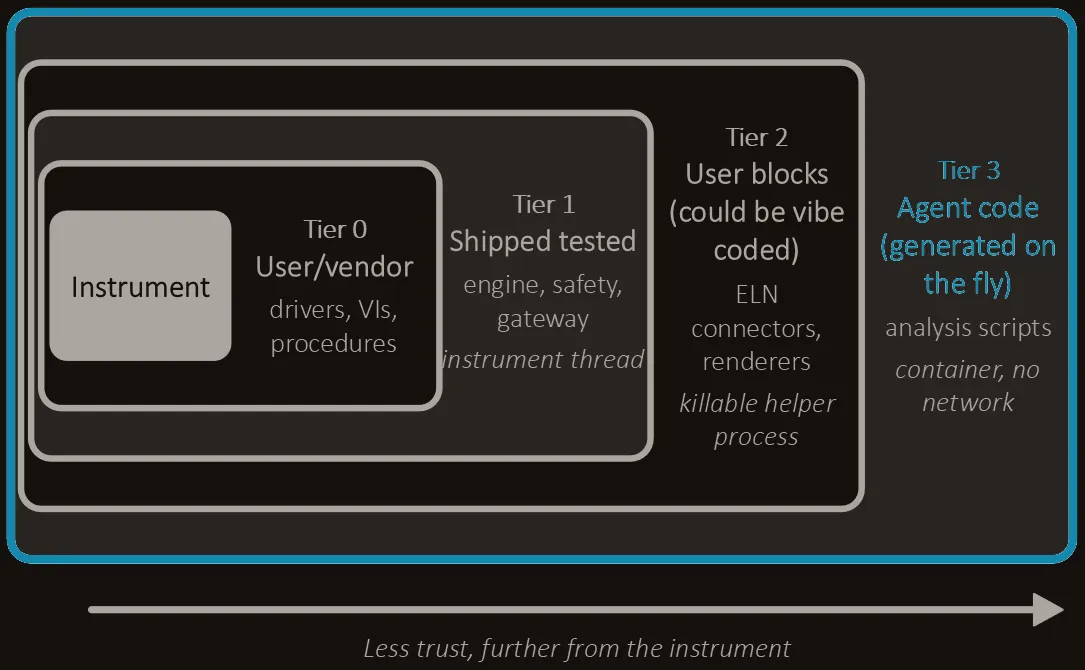 No user or agent code can affect a running experiment: the less trusted the code, the further it runs from the instrument.
Presented at AI4Sci 2026. The code is not public yet.