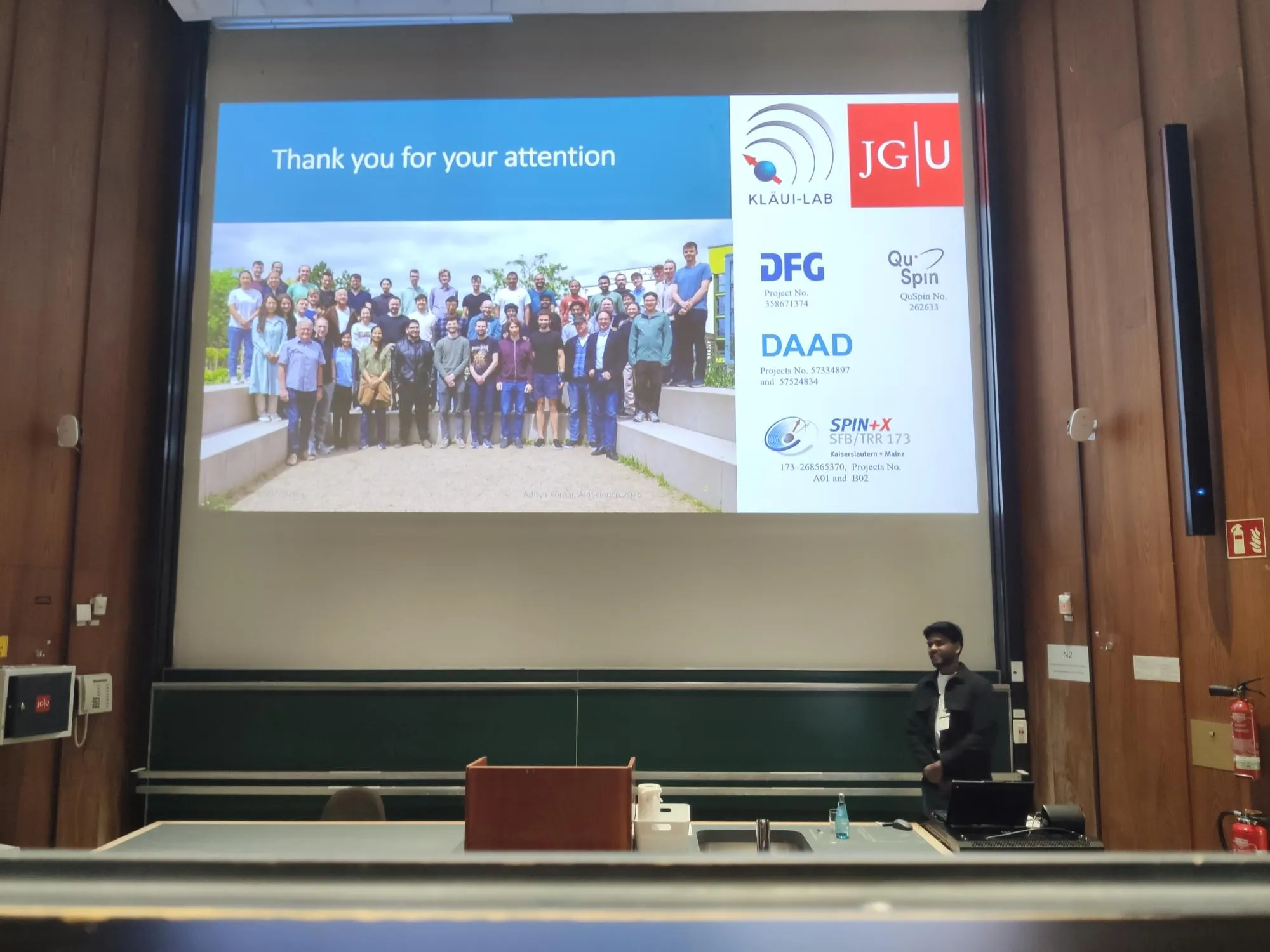
Talk
Talk at AI4Sci 2026, Mainz: accelerating experimental physics with AI
Gave a talk, "Magnetism 4 AI & AI 4 Magnetism: Accelerating Experimental Physics Research with AI", at the 2nd International Conference on AI for Science (AI4Sci 2026) in Mainz, with Kilian Leutner and Mathias Kläui as co-authors.
The talk was about a lab of the kind most public research runs on: home-built and purchased instruments put together by graduate students, with no robotic platform. The argument was that such a lab gains most by giving an AI agent three kinds of context it already has. The group's own know-how, served from the lab wiki. The field's literature, served by agentic domain-specific RAG over more than 10,000 papers and theses, which combines semantic search with walks along the citation graph and finds figures by their captions. And the experiment itself, through I2AS, where every command an agent sends to an instrument passes the same safety checks as a human's.
The roadmap in the second half was gradual augmentation on existing infrastructure. An agent first only asks the wiki and the papers, then observes the live state of an instrument, then analyses data in a sandbox, and only then acts, running procedures within set limits. Each setup goes as far up that ladder as its processes allow.