Paper
The Agentic AI Kerr Lab: LLM Agents for Kerr Microscopy Experiments with Magnetic Skyrmions
An AI agent runs a Kerr microscope to create, resize and move magnetic skyrmions. A neural network turns the live images into numbers the agent can reason on, and a separate safety layer checks every command before it reaches the instrument.
Contribution to the proceedings of the 2nd International Conference on AI for Science (AI4Sci 2026) in Mainz, submitted to Proceedings of Science. Kilian Leutner built the system, AgentKerr, and presented it; I guided the work as lead of the lab's AI and digitalization taskforce. Full text at arXiv:2611.00299.
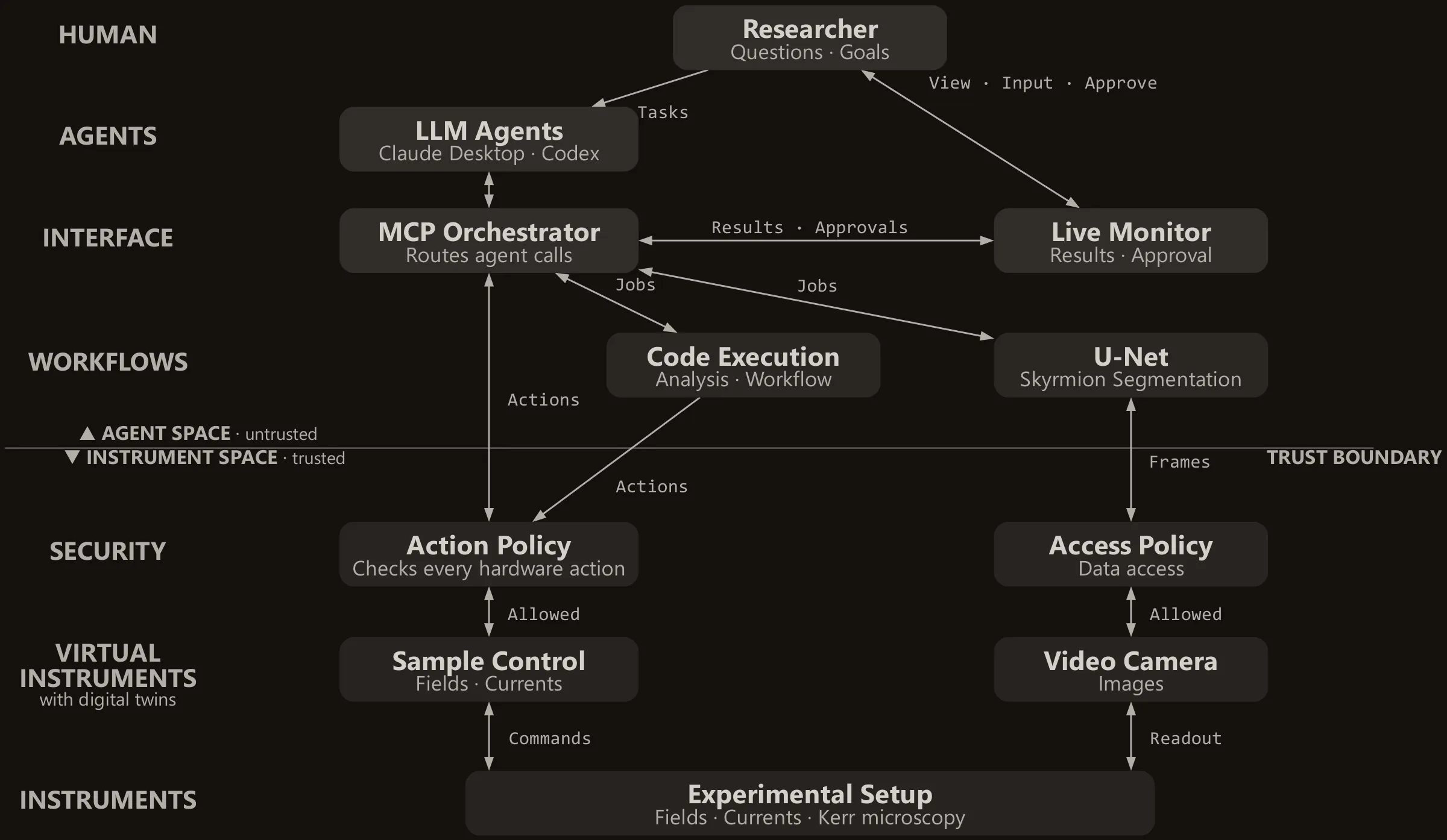
The agent drives a magneto-optical Kerr microscope through an MCP orchestrator. A U-Net segments each live image into skyrmions, defects and background at about 30 frames per second, and an action policy bounds field values, step sizes and pulse durations independently of the agent.
Figures from Leutner et al., arXiv:2611.00299, licensed CC BY 4.0: the architecture diagram is Fig. 1 with its colours inverted for this page, the thumbnail a crop of the final Kerr image in Fig. 2b.