Other
Literature-in-the-Loop at the 4th Open Scientific Intelligence Hackathon
Took part in the 4th Open Scientific Intelligence Hackathon, 21 to 22 October 2026, as team Analysis Paralysis with Sourish Dey (SumUp, Berlin) and Pratyush Kumar Das (University of Queensland).
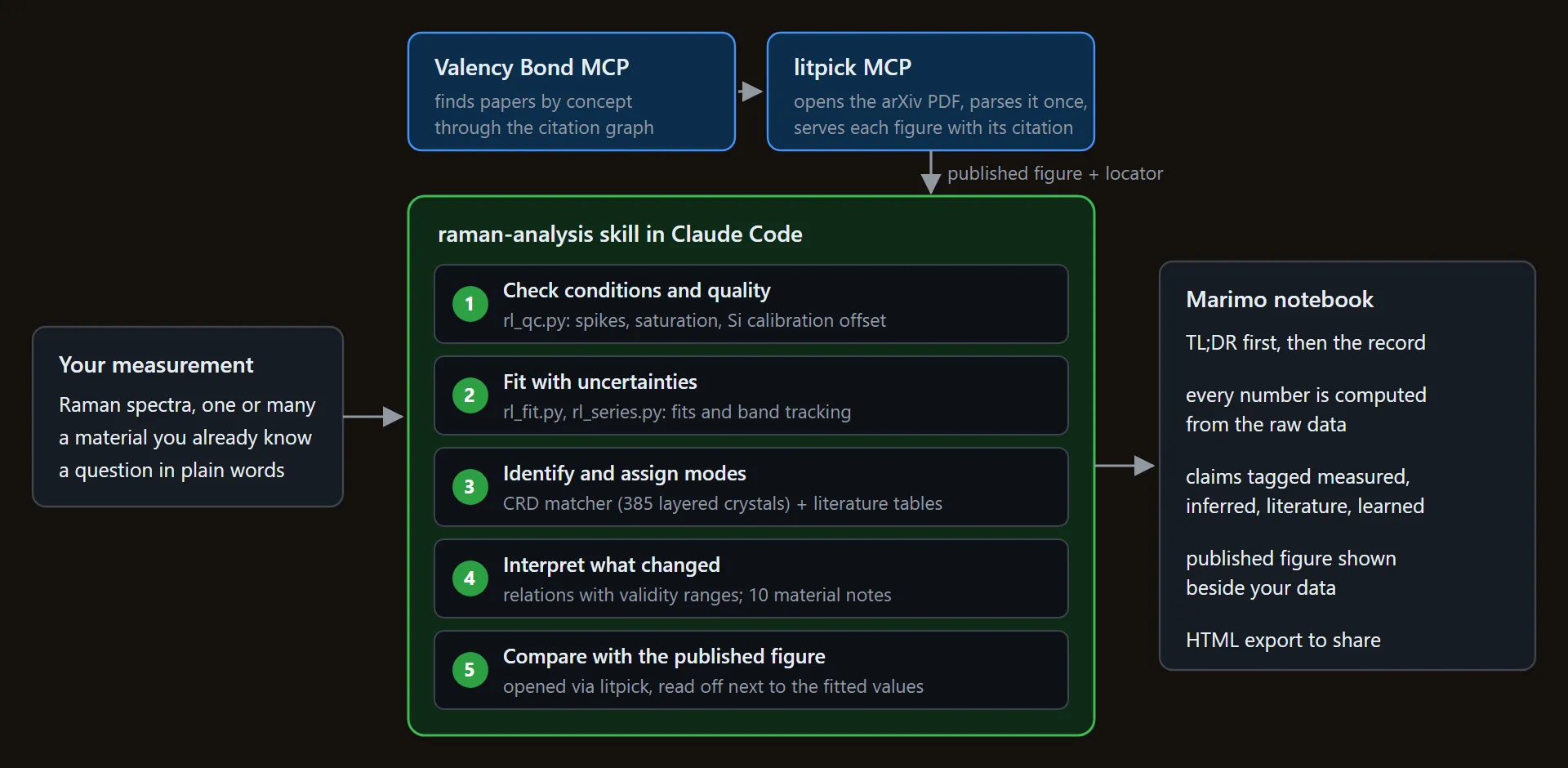
A Raman peak can shift with thickness, strain, defects, doping, temperature or a miscalibrated spectrometer. Knowing which of these to suspect is what a senior colleague brings, and no analysis tool packages it. Our project, Literature-in-the-Loop, is a Claude Code meta skill that writes an analysis skill for a measurement technique from the published literature.
The worked example is Raman spectroscopy of 2D and layered materials. The skill checks data quality, fits every band with uncertainties, identifies the material against 385 computed layered crystals and shows the published figure for the same variable beside the user's spectra, in a notebook that reruns on the raw data. Papers are opened with litpick, an MCP server Sourish and I wrote that parses a paper once and serves its figures with citations.
I wrote the Raman skill, its fitting package and the evaluation; Pratyush built the cross-domain benchmarks. On held-out cases the skill made the agent's citations more specific, and did not yet improve its interpretation score. The code is on GitHub.
The thumbnail is the skill's fit on CrSBr spectra from the project's write-up figure; the spectra are from Wdowik et al. (2025), Zenodo record 15048152, CC BY 4.0.