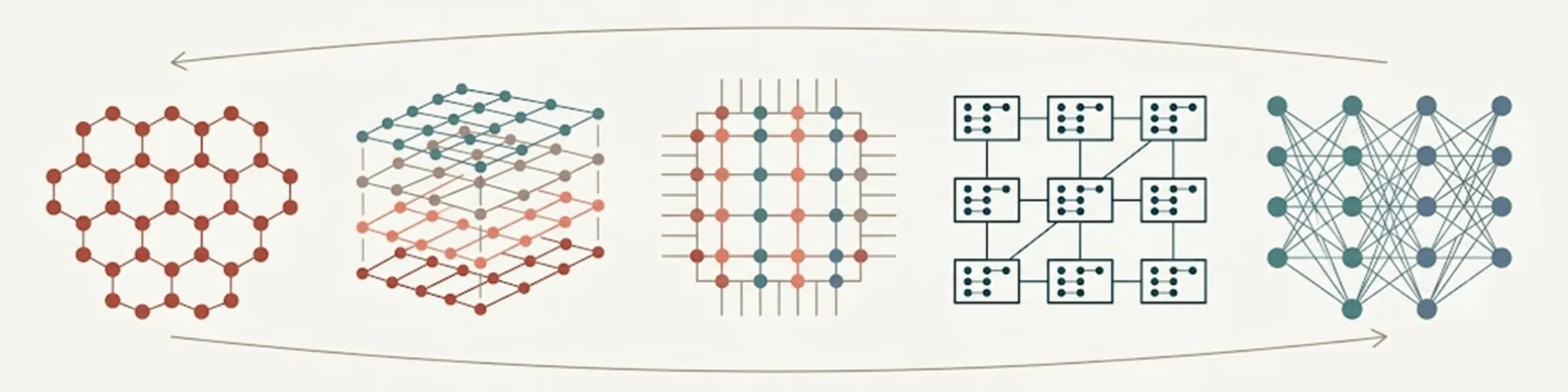
An illustration tracing a loop from a honeycomb crystal lattice through a stacked layered material, a device array, a circuit grid, and a neural network, with arrows running in both directions.

Projects

Running physics experiments for days at a time means the software running them has to be trustworthy: safe when unattended, easy to extend, and honest about what it measured. These projects are the instrument-control, data-extraction, and analysis tooling I have built to make that possible, plus one earlier machine-learning project from my computer-science minor.

A neural-network diagram of interconnected teal and slate nodes, cropped from the site's materials-to-models loop illustration, with the loop's arrows passing behind it.

Agentic AI for a Physics Lab

Python · RAG · MCP · PostgreSQL · LLM agents

A research lab's knowledge lives in scattered places: hundreds of paper PDFs, a wiki of procedures, and instruments driven by measurement software. I initiated and lead an effort in the Kläui Lab to make all three usable by AI agents without sacrificing trust: a literature assistant that cites the exact sentence behind every answer, a queryable lab wiki, and instrument control that agents can operate safely. One strand is running end to end; the other two are in early stages.

CryoSoft

PyQt6 · pyqtgraph · PyVISA · PyMeasure · h5py

The lab's cryostat measurement software used to be a flat sequence of hardcoded commands: swapping one instrument for another meant hours of rewriting code, and an unattended 20-to-30-hour overnight run had no automated safety net if something went wrong. I redesigned it as a layered system where swapping an instrument is a single config-file edit, added a safety-enforcing state machine that shuts the experiment down safely on its own, and got new lab members measuring independently in a day instead of a week.

TracEx

docling · pymatgen · quantulum3 · litellm · pytest

Scientific papers bury measured values inside paragraphs of prose, and asking a plain AI model to pull them out risks confidently wrong answers. I built a tool that tags every sentence with an ID before any AI is involved, extracts obvious numbers deterministically first, then makes exactly one tightly constrained AI call per paper, and finally re-checks every AI answer against the exact sentence it claims to come from, grading it by how well that check holds up.

Machine learning applied to conformal field theory

NumPy · Keras/TensorFlow · scikit-learn · matplotlib · Jupyter

A computer-science-minor capstone project: build neural networks that learn to classify types of quantum field theories from synthetic data, reproducing and extending results from a 2020 physics paper. Co-authored with a fellow student in autumn 2020, as an end-to-end Python pipeline running from synthetic data generation through to trained models.